What Is FinCEN? Explained in Simple Words With Examples
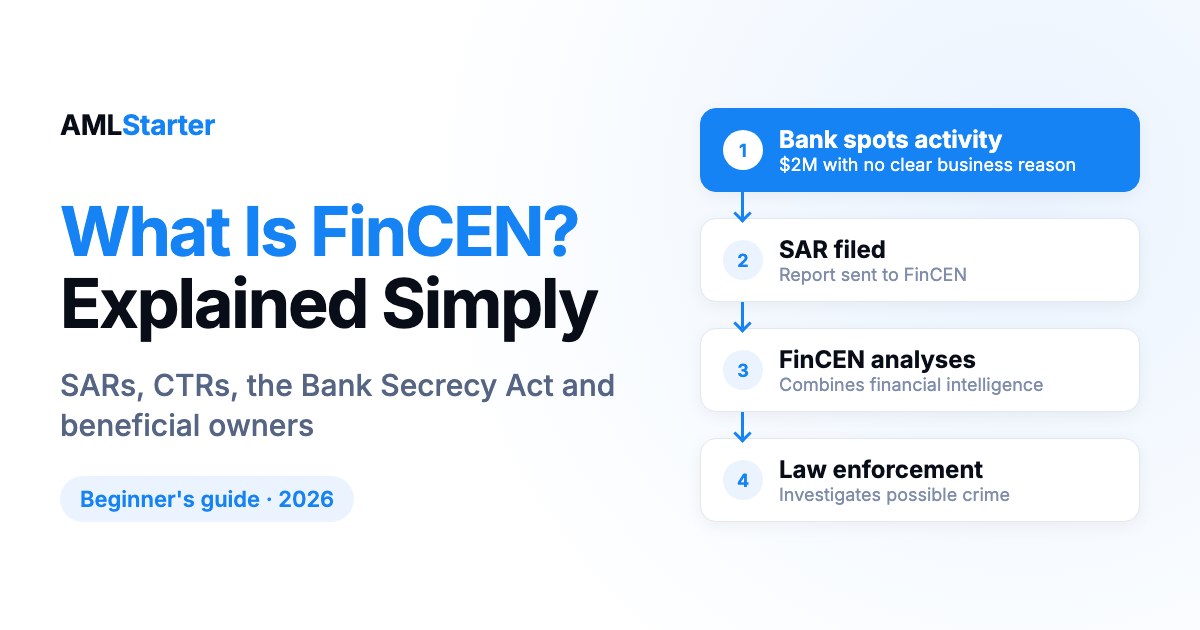
FinCEN stands for Financial Crimes Enforcement Network. It is a US government agency that helps detect and prevent money laundering and other financial crimes.
Let's understand FinCEN with a simple example. Imagine a company in the United States receives $2 million in its bank account. The company claims it sells electronic products. However, it has very little business activity, and large amounts of money are being transferred to unrelated companies overseas.
Example
From a bank account to a FinCEN report
- 1$2 million arrives
A US company says it sells electronics, but shows little real business.
- 2Bank spots a mismatch
Large sums go to unrelated companies overseas.
- 3Bank investigates
It reviews the activity and may decide it is suspicious.
- 4SAR filed
The bank submits a Suspicious Activity Report to FinCEN.
- 5FinCEN analyses
It combines the report with other intelligence and supports law enforcement.
The bank notices that these transactions do not match the company's normal business activities. It investigates and may decide that the activity is suspicious. Under US regulations, the bank may need to submit a Suspicious Activity Report (SAR) to FinCEN.
FinCEN can use this information, alongside other financial intelligence, to help law enforcement investigate possible financial crimes. This is one of the ways FinCEN works.
1. When was FinCEN established?
FinCEN was established in April 1990 and operates under the United States Department of the Treasury. It was created to help the US government collect and analyse financial information related to money laundering and other financial crimes.
In 1994, its responsibilities expanded to include administering financial crime reporting and recordkeeping requirements.
At a glance
Financial Crimes Enforcement Network (FinCEN)
The US agency for financial intelligence and AML rules
- Established
- April 1990
- Part of
- US Treasury
- Main law
- Bank Secrecy Act
- Key reports
- SAR · CTR
- 1970Bank Secrecy Act enacted
- 1990FinCEN established under the Treasury
- 1994Takes on BSA reporting and recordkeeping rules
2. What does FinCEN do?
FinCEN has four important responsibilities.
What FinCEN does
Four main jobs
Banks and certain other financial institutions submit reports to FinCEN when required by law. These help authorities understand activity that may involve crime.
Examines financial information to identify possible patterns of money laundering and other financial crimes.
Runs important US anti-money laundering requirements under the Bank Secrecy Act.
Shares relevant financial intelligence with authorised government agencies to help investigate financial crimes.
3. What is the Bank Secrecy Act (BSA)?
The Bank Secrecy Act, enacted in 1970, is a major US law that requires financial institutions to maintain certain records and submit financial reports. FinCEN administers many of the regulations under this law.
For example, banks may be required to report suspicious activities, report certain cash transactions, maintain customer records and establish AML compliance programmes.
Law and agency
How the BSA and FinCEN fit together
- Report suspicious activity
- Report certain cash transactions
- Keep customer records
- Run an AML compliance programme
In simple words: BSA is the law, and FinCEN is the government agency responsible for administering and enforcing important parts of it.
4. What is a Suspicious Activity Report (SAR)?
A SAR is a report filed by a financial institution when certain activity raises suspicion of money laundering, fraud or other potentially illegal conduct, and the applicable reporting requirements are met.
Example: ABC Trading LLC normally receives $20,000 every month from its customers. Suddenly, it begins receiving hundreds of thousands of dollars from unrelated companies, without a clear business explanation.
Spot the change
ABC Trading LLC: incoming payments per month
Illustrative figures. Normal activity is about $20,000 a month.
Why the bank looks closer: the money does not match the customer's known business, and there is no clear explanation.
The bank investigates the unusual activity and may determine that filing a SAR is required.
A SAR does not automatically mean that the customer has committed a crime. It provides information for authorities to assess.
5. What is a Currency Transaction Report (CTR)?
A Currency Transaction Report is another important report used in the United States. Banks generally must file a CTR when a customer conducts currency transactions totalling more than $10,000 in one business day, subject to applicable aggregation and exemption rules.
For example, if a company deposits $15,000 in cash into its bank account, the transaction generally falls within the CTR reporting requirements unless an applicable exemption applies.
Try it
Would this day's cash need a CTR?
Add up one customer's cash deposits and withdrawals for a single business day.
Simplified. Banks generally aggregate cash transactions by or for the same person in one business day. Exemptions and other rules can apply.
The important difference between the two reports:
Compare
SAR vs CTR
- Reports qualifying suspicious activity
- Trigger suspicion and the applicable rules
- Threshold no single universal dollar amount
- Nature filing is confidential
- Reports qualifying cash transactions
- Trigger cash totalling more than $10,000 in a business day
- Threshold a specific cash amount
- Nature routine regulatory reporting
A CTR is not an accusation of criminal behaviour.
6. How does FinCEN affect Corporate KYC?
Let's say ABC Manufacturing LLC wants to open an account with a US bank. The bank needs to know whether the company is legally registered, what business it performs, who owns it and who controls it.
FinCEN's Customer Due Diligence (CDD) Rule plays an important role here. It generally requires covered financial institutions to identify and verify relevant beneficial owners of covered legal entity customers, along with other due diligence requirements.
Example: identifying beneficial owners
ABC Manufacturing LLC has three individual shareholders. Under FinCEN's general CDD ownership test, a natural person owning 25% or more qualifies as a beneficial owner through ownership. Try changing the percentages below.
Interactive
ABC Manufacturing LLC: who is a beneficial owner?
Change the ownership percentages. Anyone with 25% or more passes the ownership test.
In the original split, Person A and Person B meet the ownership test. The CDD Rule also requires identification of one individual who has significant responsibility for managing or controlling the company. So identifying shareholders alone is not always enough.
7. What is FinCEN's CDD Rule?
CDD stands for Customer Due Diligence. The CDD Rule helps financial institutions understand who their customers are and why they are using financial services. Its main requirements cover four areas.
CDD Rule
Four requirements
- 1Identify and verify customers
Confirm who the customer is.
- 2Identify and verify beneficial owners
For legal entity customers: the 25% owners and one control person.
- 3Understand the relationship
Know the purpose and nature of the account to build a customer risk profile.
- 4Monitor and update
Watch activity and keep customer information current.
On 13 February 2026, FinCEN gave covered institutions relief from re-checking beneficial owners every time an existing legal entity customer opens another account. The check is now needed:
- when the customer opens its first account
- when earlier information becomes questionable
- when risk-based procedures call for a fresh check
8. What is Beneficial Ownership Information (BOI)?
Beneficial Ownership Information means information about the individuals who ultimately own or control a company. FinCEN also administers beneficial ownership reporting under the Corporate Transparency Act (CTA).
However, bank CDD requirements and CTA beneficial ownership reporting are two different things.
Two different things
Bank CDD vs CTA BOI reporting
Bank CDD (onboarding)
- Who collects
- The bank, from its customer
- When
- When the company becomes a customer, and as risk requires
- Rule
- FinCEN CDD Rule under the BSA
- Status
- Still applies
CTA BOI reporting
- Who files
- The company, directly to FinCEN
- Law
- Corporate Transparency Act
- March 2025 change
- US-created companies and US persons exempt
- Status
- Certain foreign-formed companies registered in the US may still report
The BOI reporting exemption does not remove a bank's separate CDD obligations.
9. What is the difference between FATF and FinCEN?
This is a common interview question.
Interview favourite
FATF vs FinCEN
| FATF | FinCEN | |
|---|---|---|
| What it is | International organisation | US government agency |
| Established | 1989 | 1990 |
| Main role | Sets global AML/CFT standards | Administers and enforces US financial crime regulations |
| Checks | Evaluates countries | Collects and analyses financial intelligence |
| Key rules | 40 Recommendations | Requirements under the BSA |
| Reach | International | United States |
Simple example: FATF recommends that countries establish effective customer due diligence requirements. FinCEN administers US CDD regulations that apply to covered financial institutions. New to FATF? Read What Is FATF? Explained in Simple Words.
10. Why should Corporate KYC analysts know about FinCEN?
If you work with US corporate customers or US-regulated financial institutions, FinCEN requirements are particularly important.
Your work may involve checking company registration documents, identifying beneficial owners, understanding business activities, investigating unusual customer information and helping maintain accurate CDD records.
You should also understand the difference between identifying a UBO for bank onboarding and filing BOI with FinCEN under the Corporate Transparency Act.
Quick check
Quick check
5 questions on FinCEN
Pick an answer to see if you are right.
Conclusion
FinCEN is a US government agency established in 1990 to help protect the financial system from money laundering and other financial crimes. It collects and analyses financial intelligence, administers important BSA regulations and supports law enforcement.
For Corporate KYC professionals, FinCEN is particularly important because its CDD requirements help determine how covered US financial institutions identify companies, verify beneficial owners and monitor customer relationships.
Remember: FATF sets international AML standards, while FinCEN administers and enforces important US financial crime requirements.
Practise Corporate KYC on real cases
Work through beneficial ownership, CDD and suspicious activity cases with lessons, a KYC simulator and interview practice.
Explore AMLStarterSources
Research checked on 9 October 2026. FinCEN rules change; check the official pages for the current requirements.