What Is FATF? Explained in Simple Words With Examples
Imagine a person earns ₹10 crore through illegal activities. They know that depositing this money directly into a bank might raise questions. So they create a company and start moving the money through different businesses and countries. After some time, the money may appear to be legitimate business income.
This is called money laundering.
Now imagine one country has strict banking rules, but another country barely checks where money comes from. Criminals can take advantage of the country with weaker rules. This is where FATF comes in.
1. What is FATF?
FATF stands for Financial Action Task Force. It is an international organisation that helps countries fight money laundering, terrorist financing and related financial crimes.
In simple words, FATF helps countries create strong rules so criminals cannot easily misuse banks and financial systems.
At a glance
Financial Action Task Force (FATF)
The global standard-setter for fighting financial crime
- Founded
- 1989
- Created by
- G7 countries
- Standards
- 40 Recommendations
- Covers
- ML · TF · PF
What FATF does
- Sets international standards
- Evaluates countries
- Lists countries with serious weaknesses
- Helps countries improve
What FATF does not do
- Open bank accounts
- Check individual bank customers
- Arrest criminals
- Normally fine banks
ML = money laundering · TF = terrorist financing · PF = proliferation financing
Think of FATF as an organisation that sets common standards for countries to follow. It does not open bank accounts, check every bank customer or arrest criminals itself.
2. When and why was FATF created?
FATF was established in 1989 by the G7 countries. At that time, governments were concerned about criminals moving money earned from illegal drug trafficking through banks and across borders.
Countries realised that fighting money laundering individually was not enough. For example, even if the United Kingdom had strong banking rules, criminals could move money through another country with weaker controls.
The problem in 1989
Criminals use the weakest link
One country with strong rules is not enough if money can pass through a country with weak controls.
The answer: common standards for every country, so there is no easy weak link to use. That is the job FATF was created for.
Countries needed to work together. That is why FATF was created. Over time, FATF expanded its work to cover terrorist financing and financing linked to weapons of mass destruction.
Timeline
How FATF's scope grew
- 1989Founded by the G7
Focus: money laundering, especially drug trafficking money moving through banks.
Money laundering - 2001Terrorist financing added
After the September 2001 attacks, FATF added standards to stop money reaching terrorist groups.
Terrorist financing - 2012Revised 40 Recommendations
The standards were rewritten as one set covering all three risks, including the financing of weapons of mass destruction.
Proliferation financing
3. What does FATF actually do?
FATF mainly does four things.
What FATF does
Four main jobs
Tells countries which measures they need: checking bank customers, identifying company owners, reporting suspicious transactions.
Evaluates whether a country has proper anti-money laundering systems, and whether those systems actually work.
Places countries under increased monitoring (grey list) or, in serious cases, calls for action (black list).
Identifies the weaknesses, agrees what needs fixing, and monitors how the country addresses them.
First, FATF creates standards. It tells countries what measures they should have to prevent financial crime. These include checking bank customers, identifying company owners and reporting suspicious transactions.
Second, FATF checks countries. It evaluates whether countries have proper anti-money laundering systems and whether those systems actually work.
Third, FATF identifies countries with serious weaknesses. If a country has problems with its financial crime controls, FATF may place it under increased monitoring, commonly called the grey list. For more serious situations, FATF may classify a country as high-risk and call for stronger measures.
Fourth, FATF helps countries improve. It identifies weaknesses and monitors how countries address them.
4. How does FATF work with banks?
Let's understand this with a simple example. Suppose you own a company called ABC Trading Ltd and want to open a business bank account. The bank may ask you these questions.
Example
ABC Trading Ltd wants a business account
Tap each question to see why the bank asks it.
All six questions are part of KYC. The bank asks them because the law requires it, and that law is based on FATF's customer due diligence standard.
Why does the bank ask these questions? Because banks must understand their customers and reduce the risk of being used for financial crime. This process is called Know Your Customer (KYC).
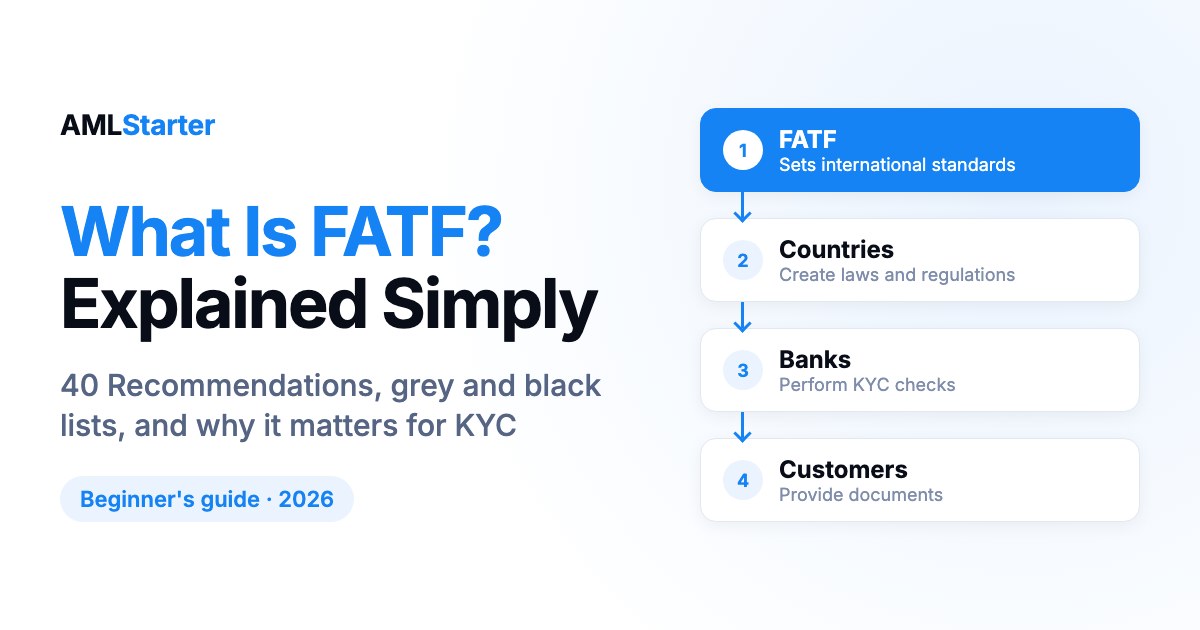
FATF creates international standards for customer due diligence. Countries use these standards when developing their banking laws, and banks follow the applicable laws. So the relationship looks like this:
How it connects
From FATF to the customer
Select a level to see its role in the ABC Trading example.
5. What are FATF's 40 Recommendations?
FATF has created 40 Recommendations. Don't worry about memorising all 40. Think of them as 40 important standards that help countries fight financial crime. For example:
- Banks should know who their customers are.
- Banks should identify the real owners of companies.
- Financial institutions should keep required records.
- Suspicious transactions should be reported to the appropriate authorities.
- Countries should have proper systems to investigate money laundering.
- Countries should cooperate when financial crime involves multiple jurisdictions.
The 40 Recommendations
You don't need all 40. Start with these.
Highlighted squares are the ones KYC analysts meet most often. Select one to read about it.
Each recommendation covers a particular area. For example, Recommendation 10 focuses on Customer Due Diligence, while Recommendation 24 focuses on beneficial ownership transparency for companies.
6. What is the FATF grey list?
Imagine a country has weak systems for detecting money laundering. Maybe its banks are not properly supervised, or authorities struggle to identify the real owners of companies. FATF identifies these problems and asks the country to improve.
If FATF places that country under increased monitoring, people commonly say it is on the FATF grey list. Grey-listing means the country has agreed to work on identified weaknesses.
Grey-listing does not mean everyone in that country is a criminal, and it does not automatically mean banks must stop dealing with the country.
7. What is the FATF black list?
The FATF black list is the common name for its list of High-Risk Jurisdictions Subject to a Call for Action. These countries have serious weaknesses in their systems for fighting financial crime.
FATF calls for stronger checks and, in the most serious cases, countermeasures to protect the international financial system. The difference is simple:
Two FATF lists
Grey list vs black list
| Grey list | Black list | |
|---|---|---|
| Official name | Jurisdictions under Increased Monitoring | High-Risk Jurisdictions Subject to a Call for Action |
| Problem | Important weaknesses | Serious strategic weaknesses |
| FATF's response | Closely monitors improvements | Calls for stronger protective measures |
| What happens | Country works through an agreed action plan | Enhanced checks and, in the most serious cases, countermeasures |
Both lists change over time. Always check the latest version on the FATF website.
8. Can a country be removed from the grey list?
Yes. Suppose FATF finds that a country has weak customer verification rules. The country then improves its laws, strengthens bank supervision and shows that the improvements are working. FATF reviews the progress.
Example
The path off the grey list
- 1Weakness found
FATF finds the country has weak customer verification rules.
- 2Action plan agreed
The country commits to fix the weaknesses and is placed under increased monitoring.
- 3Reforms made
It improves its laws, strengthens bank supervision and shows the changes are working.
- 4FATF reviews progress
The action plan must be completed and pass the required review.
- ✓Removed from the list
Increased monitoring ends.
If the country completes its agreed action plan and the required review, FATF can remove it from increased monitoring. This shows that FATF's purpose is not simply to put countries on lists. It is also to encourage countries to improve their financial crime prevention systems.
9. Why should a Corporate KYC analyst understand FATF?
If you work in Corporate KYC, many of your daily activities are connected to FATF standards. When you verify a company's registration, identify its real owners, understand its business activities or assess the risk of a corporate customer, you are doing work influenced by FATF's global standards.
Corporate KYC
Your daily task, and the FATF standard behind it
- Verify the company's registrationR10 · Customer due diligence
- Identify the real owners (UBOs)R24 · Beneficial ownership
- Understand the business activityR10 · Customer due diligence
- Assess the customer's riskR1 · Risk-based approach
- Screen directors and owners for PEPsR12 · Politically exposed persons
- Escalate unusual activityR20 · Suspicious transaction reporting
Why ownership matters: layers can hide the real owner
For example, FATF promotes beneficial ownership transparency because criminals sometimes hide behind several layers of companies. That is why understanding who ultimately owns or controls a corporate customer is such an important part of KYC.
10. Does FATF directly punish banks?
No. FATF does not normally issue fines to banks. It establishes standards and evaluates how countries implement them.
National regulators and other competent authorities enforce their own laws and may impose penalties on institutions that violate those laws. For example, an Indian bank may face regulatory action under applicable Indian requirements, rather than receiving a direct fine from FATF.
Who does what
FATF sets the standard. National authorities enforce the law.
FATF
- Sets international standards
- Evaluates countries
- Publishes the grey and black lists
National regulators
- Write and enforce national law
- Supervise banks
- Impose penalties for breaking the law
Quick check
Quick check
5 questions on FATF
Pick an answer to see if you are right.
Conclusion
FATF was created in 1989 to help countries fight money laundering. Its responsibilities later expanded to terrorist financing and proliferation financing.
Today, FATF helps countries build stronger financial crime prevention systems through its 40 Recommendations, country evaluations, international cooperation and monitoring of jurisdictions with serious weaknesses.
For a Corporate KYC analyst, FATF explains much of the reasoning behind company verification, beneficial ownership checks, risk assessment and ongoing monitoring.
The easiest way to remember FATF: FATF sets international standards, countries create rules based on those standards, and banks follow the applicable rules to help prevent financial crime.
Put FATF standards into practice
See how CDD, beneficial ownership and risk assessment work on real cases with lessons, a KYC simulator and interview practice.
Explore AMLStarterSources
FATF's lists change after each Plenary meeting. Check the official pages for the current version.