Source of Funds vs Source of Wealth: Explained Simply With Examples
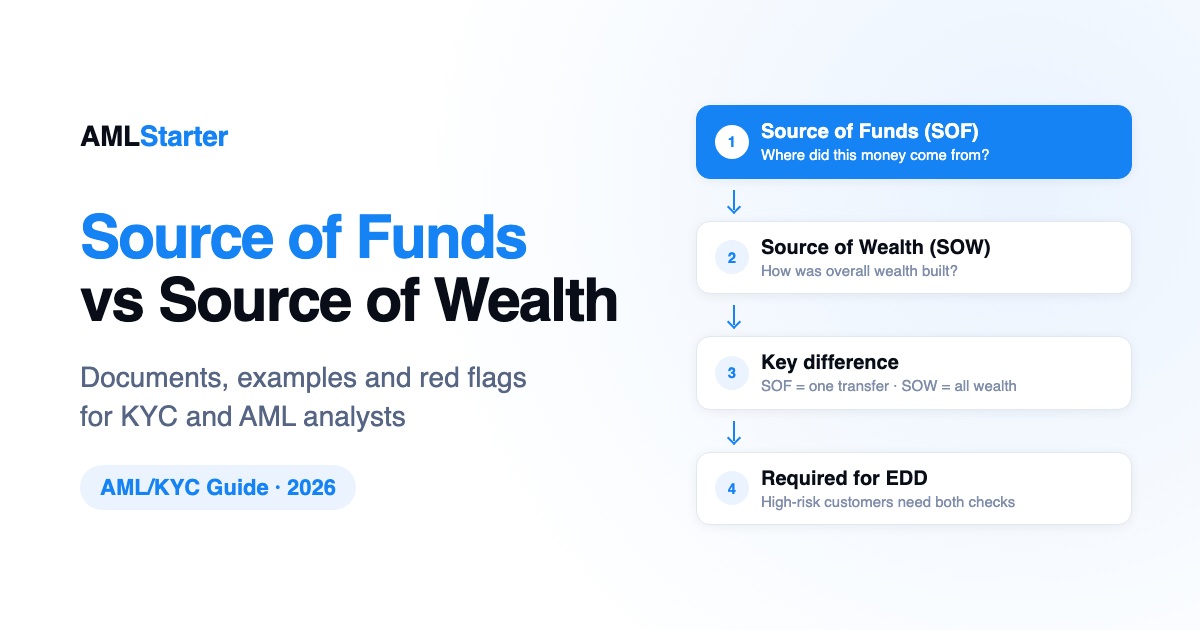
Source of Funds and Source of Wealth are two checks that financial institutions carry out as part of Customer Due Diligence. They sound similar but they answer different questions — and mixing them up is one of the most common mistakes in KYC interviews.
Imagine a business owner named Rahul who runs a manufacturing company. Over 15 years, his company earned profits, purchased properties and made investments. He has built up wealth worth ₹10 crore. One day, he transfers ₹50 lakh into a new bank account.
The bank wants to understand two things: where did the ₹50 lakh come from, and how did Rahul build his overall wealth of ₹10 crore? These questions look similar but they are not.
The first question is about Source of Funds (SOF). The second is about Source of Wealth (SOW).
1. What Is Source of Funds?
Source of Funds means understanding where the money used for a specific transaction or business relationship comes from.
In simple words, it answers: "Where did this particular money come from?"
Example
ABC Trading Ltd receives ₹25 lakh in its bank account. The bank asks the company to explain the payment. The company says the money was received from a customer for supplying electronic equipment, and it provides a sales invoice, purchase order and payment details.
The analyst reviews the information to understand whether the payment is consistent with the company's business. In this case, the Source of Funds is revenue from the sale of electronic equipment.
A bank statement shows which account sent the money, but it does not always explain how the money was originally generated. Both pieces of information may be needed.
Common examples of Source of Funds include: business sales revenue, salary or employment income, proceeds from a property sale, a bank loan, dividend payments, shareholder capital contributions, inheritance, and proceeds from investments.
2. What Is Source of Wealth?
Source of Wealth means understanding how a person or company accumulated its overall wealth over time.
In simple words, it answers: "How did the customer become wealthy?"
Example
Mr Sharma owns a construction company. He started the business in 2005 with a small investment. Over the next 20 years, his company completed several construction projects and earned substantial profits. He also purchased commercial properties and invested in other businesses. Today, his estimated wealth is ₹20 crore.
The Source of Wealth includes profits from his construction business, income from property investments and returns from other investments. The bank wants to understand whether this explanation is reasonable given his business history.
The Wolfsberg Group describes Source of Wealth as understanding the activities that generated or significantly contributed to a customer's overall wealth.
3. The Difference Between Source of Funds and Source of Wealth
Compare
Source of Funds vs Source of Wealth
- Question Where did this money come from?
- Scope A specific transaction or account
- Focus A particular amount at a point in time
- Example ₹50 lakh received from a property sale
- Evidence Invoices, contracts, transaction records
- Question How was overall wealth accumulated?
- Scope Full financial history of the customer
- Focus Accumulated assets and financial resources
- Example ₹10 crore built through business profits and investments
- Evidence Financial statements, business history, investment records
An easy way to remember the distinction:
- SOF = Where did this money come from?
- SOW = How was the overall wealth built?
4. One Example That Shows Both
ABC Manufacturing Ltd has operated for 20 years and has accumulated substantial assets through its manufacturing operations. The company opens a new bank account and deposits ₹1 crore from the sale of a factory building.
Example
ABC Manufacturing Ltd
Established manufacturing business — 20 years of operations
Both can be correct at the same time. The ₹1 crore has a specific source; the broader wealth was built over two decades.
The ₹1 crore deposit has a specific source: the sale of a factory. But the company's broader wealth comes from many years of operating its manufacturing business and holding assets. Both explanations can be correct at the same time.
5. What Documents Can Be Used to Verify SOF and SOW?
KYC analysts do not always need the same documents for every customer. The evidence required depends on the type of customer, the amount involved, the identified risks and applicable policies.
Documents
Source of Funds: common supporting documents
Documents
Source of Wealth: common supporting documents
The purpose is not simply to collect documents. The analyst must decide whether the evidence reasonably supports the customer's explanation. The Wolfsberg Group recommends a risk-based approach when deciding how much information and corroboration to obtain.
6. Why Do Banks Check SOF and SOW?
Suppose a customer claims to operate a small business earning ₹5 lakh per year. Suddenly, the customer receives ₹5 crore from an unknown company.
The bank needs to understand whether the payment comes from a legitimate activity. It may be a major contract payment, a business sale, an investment exit or another reasonable source. But if the customer cannot explain the payment, or the explanation conflicts with other information, further investigation may be needed.
SOF and SOW checks help banks assess whether a customer's financial background and account activity make sense together. They also help identify potential money laundering, corruption, fraud or other financial crime risks.
7. SOF and SOW in Corporate KYC
In Corporate KYC, analysts may need to understand both the company's funding and the wealth of relevant owners or controllers.
For example, a newly incorporated company is funded with ₹10 crore by its shareholder. The company explains that the money is a capital investment. That tells the analyst the immediate funding arrangement.
But the analyst may also need to understand how the shareholder obtained ₹10 crore. If the shareholder claims the money came from 15 years of profits earned through a successful logistics business, this may form part of the Source of Wealth explanation. Depending on the risk, the bank may seek supporting evidence.
Important: Source of Wealth checks on beneficial owners are not automatically required to the same depth for every corporate customer. The bank follows its applicable legal and risk-based requirements.
8. Common Red Flags Related to SOF and SOW
A red flag does not prove wrongdoing. It means the analyst should investigate further.
Red flags
SOF and SOW: signs that need further investigation
9. Practical Case Study
Scenario: XYZ Holdings Ltd is a newly incorporated company. During onboarding, it declares that it will receive ₹3 crore from its director as an initial investment. The company provides the director's name and bank account details but does not explain how the director obtained the investment money.
What should the analyst do?
First, establish the nature of the proposed funding. Is it share capital, a shareholder loan or another arrangement?
Next, understand where the ₹3 crore will come from and, where required, how the director accumulated the wealth used to finance the company.
Possible supporting information could include business income records, asset sale documents, investment statements or other relevant evidence.
If the explanation is reasonable and appropriately supported, the analyst documents the findings. If material inconsistencies remain, the case may require enhanced due diligence or escalation.
10. Common Interview Question: What Is the Difference Between SOF and SOW?
Interview question
What is the difference between Source of Funds and Source of Wealth?
Source of Funds refers to the origin of money involved in a specific transaction or account funding. Source of Wealth refers to how a customer accumulated their overall wealth over time.
For example, if a business owner transfers ₹50 lakh into an account from the sale of a property, the property sale is the Source of Funds. If the business owner accumulated wealth through 20 years of business profits and investments, those activities explain the Source of Wealth.
Both checks help financial institutions understand a customer's financial background and assess potential financial crime risks.
Conclusion
Source of Funds and Source of Wealth are closely related but they answer different questions.
Source of Funds helps the bank understand the origin of money used in a particular transaction or relationship. Source of Wealth helps the bank understand how the customer built their overall wealth.
For a KYC analyst, the goal is not simply to obtain a bank statement or financial document. It is to understand whether the customer's explanation is reasonable, consistent and supported by suitable evidence.
Remember: SOF explains the money being used. SOW explains how the wealth was accumulated.
Practise Corporate KYC on real cases
Work through SOF, SOW, beneficial ownership and CDD cases with lessons, a KYC simulator and interview practice.
Explore AMLStarterSources
Research checked on 11 October 2026.